AI vs Google Search: How People Are Finding Information in 2026
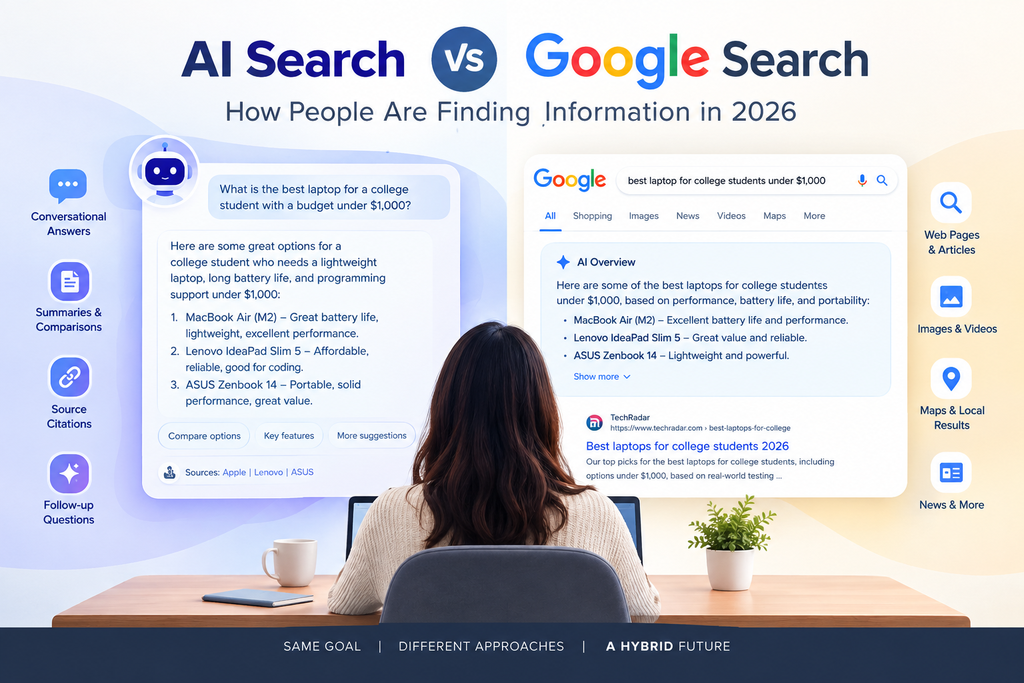
For years, Google Search has been the starting point for finding information online. Whether people wanted to research a product, find a restaurant, read the latest news, compare services, or answer a question, Google Search provided a list of relevant websites and other search results.
In 2026, the search experience is changing rapidly.
Users can now ask increasingly detailed questions to AI-powered search engines and assistants and receive conversational answers, summaries, comparisons, recommendations, and links to supporting sources.
This has created an important question for users, marketers, publishers, and businesses:
What is the difference between AI Search vs Google Search, and how is search behavior changing in 2026?
The answer is more complicated than simply saying that AI search is replacing Google.
Google itself is integrating artificial intelligence directly into Search through experiences such as AI Overviews and AI Mode. At the same time, standalone AI assistants are becoming increasingly useful for research and information discovery.
As a result, traditional search and AI search are increasingly becoming part of the same broader search ecosystem.
What Is AI Search?
AI search refers to search experiences that use artificial intelligence to understand a user’s question, retrieve relevant information, and generate or organize an answer.
Traditional search generally presents users with a collection of links and other search features. AI search can go a step further by interpreting the context behind a query and synthesizing information into a conversational response.
For example, instead of searching:
“best laptops for college students”
a user might ask:
“What is a good lightweight laptop for a college student who needs long battery life, programming support, and a budget under $1,000?”
An AI-powered search system can interpret the different requirements in that question and organize an answer around them.
Depending on the platform, AI search can provide:
- Direct answers
- Summaries
- Source citations
- Comparisons
- Follow-up questions
- Recommendations
- Step-by-step explanations
- Context from previous questions
This makes AI search particularly useful for research-heavy and conversational queries.
What Is Traditional Google Search?
Traditional Google Search is designed primarily to help users discover relevant information across the web.
A user enters a query and receives results that can include:
- Websites
- Images
- Videos
- News
- Maps
- Products
- Local businesses
- Featured results
- Other specialized search features
For example, a user searching for “best CRM software for small businesses” might see software companies, review websites, comparison articles, videos, and other resources.
The user then opens different results and evaluates the information.
However, it is important to understand that Google Search in 2026 is not purely traditional search anymore.
Google has integrated AI directly into its search experience through AI Overviews, AI Mode, and other AI-powered features. Therefore, the distinction between “Google Search” and “AI search” is becoming increasingly blurred.
AI vs Google Search: Key Differences
The biggest difference between AI Search vs Google Search is how each experience handles the user’s information need.
| Feature | Traditional Google Search | AI Search |
|---|---|---|
| Query style | Often keyword-based | Often conversational |
| Primary purpose | Discover information | Understand and synthesize information |
| Main output | Links and search results | Generated answers and sources |
| Follow-up questions | Usually separate searches | Often part of one conversation |
| Comparisons | User compares results | AI can organize comparisons |
| Research | User visits multiple pages | AI can summarize multiple sources |
| Context | Primarily query-based | Can use conversational context |
| User experience | Search and browse | Ask, refine, and discuss |
| Best use | Finding specific pages and sources | Exploring complex questions |
These differences are not absolute. Modern Google Search increasingly uses AI, while AI assistants can also direct users toward websites and original sources.
How AI Search Is Changing Search Queries
One of the most important AI search trends is the increasing use of longer and more conversational queries.
Traditional search encouraged people to shorten their questions.
For example:
“best marketing software”
With AI search, a user might write:
“I run a small online business with a three-person marketing team. Which marketing software should we consider if we need email automation, customer segmentation, analytics, and an affordable monthly plan?”
The second query contains much more information about the user’s:
- Situation
- Goals
- Requirements
- Constraints
- Preferences
This means search intent is becoming increasingly important.
AI systems can interpret the context within a question instead of relying only on individual keywords.
Conversational Search Creates a Different User Journey
Traditional search often follows this pattern:
Search → Open result → Read → Return to search → Search again
AI search can create a different journey:
Ask → Receive answer → Ask follow-up → Refine question → Compare information → Make a decision
This makes search more conversational.
Instead of creating several independent searches, users can continue asking questions within the same conversation.
For example:
User: What is generative AI?
Follow-up 1: How is it different from traditional machine learning?
Another Follow-up 2: How are businesses using it?
Then again another Follow-up 3: What are the risks?
The conversation can continue without starting from scratch each time.
Google AI Search: AI Overviews and AI Mode
One of the most significant developments in Google AI Search is the integration of AI directly into Google’s search experience.
Google’s AI Overviews provide AI-generated summaries for certain queries, while AI Mode is designed for more conversational and complex searches.
Google has reported rapid adoption of its AI-powered search features and continued expansion of AI Mode during 2026.
This is important because it demonstrates that AI search is not necessarily a competitor completely separate from Google.
Instead, Google itself is becoming an AI-powered search platform.
The traditional search results page and AI-generated responses can exist within the same search journey.
Where Traditional Google Search Still Has an Advantage
AI search is useful for many tasks, but traditional search remains valuable.
Finding Specific Websites
If you already know where you want to go, a traditional search result can be extremely efficient.
Examples include:
- A company’s official website
- Google Search Console
- A government website
- A university website
- A specific product page
- An online publication
The user does not necessarily need a long AI-generated explanation.
They simply need the correct destination.
Accessing Original Sources
For important information, users may want to read the original source themselves.
This can include:
- Research papers
- Government reports
- Official announcements
- Product documentation
- Financial reports
- Legal documents
- Company policies
An AI summary can be useful for understanding the material, but the original source remains important when accuracy and context matter.
Exploring Multiple Search Results
Traditional Google Search also makes it easy to see different websites and perspectives at once.
This can be valuable when users want to compare sources rather than rely on a single synthesized answer.
Where AI Search Can Be More Useful
AI search can be especially useful when a task requires understanding or synthesis.
Complex Questions
Users can describe an entire problem instead of reducing it to a few keywords.
For example:
“Explain how a small business can use AI automation to reduce repetitive administrative work without replacing human customer support.”
This contains several connected concepts that would otherwise require multiple searches.
Comparisons
AI systems can organize information according to specific criteria.
A user could ask:
“Compare these three project management tools for a remote team of 20 people. Focus on pricing, automation, collaboration, integrations, and ease of use.”
The AI can structure the response around those criteria.
Users should still verify important claims against the original product documentation.
Research and Planning
AI search can also help users organize research.
For example, someone researching a new business idea could ask an AI system to explain:
- The target market
- Major competitors
- Customer problems
- Potential business models
- Relevant technologies
- Risks
- Questions requiring additional research
This can make the initial research process more conversational and structured.
AI Search Does Not Mean Websites Are Dead
The growth of AI search has created concerns among publishers and businesses.
If an AI system answers a question directly, why would users visit websites?
This is an important question, but it does not mean websites are becoming irrelevant.
AI search still depends heavily on information from the web and other sources.
For businesses and publishers, the goal should therefore be to create content that provides genuine value rather than simply producing pages designed around keywords.
High-quality content should include:
- Accurate information
- Clear explanations
- Original insights
- Relevant examples
- Authoritative sources
- Specific details
- Updated information
- Clear organization
Content that provides original information can be particularly valuable in an AI-driven search environment.
What AI Search Means for SEO
The growth of AI search does not mean SEO is dead.
Instead, SEO is evolving.
Traditional SEO continues to involve areas such as:
- Technical accessibility
- Crawling and indexing
- Search intent
- Relevant keywords
- Internal linking
- Content quality
- Authority
- User experience
AI-powered search adds another consideration: whether information can be easily understood, retrieved, summarized, and attributed.
This is why marketers increasingly discuss terms such as AI SEO, Answer Engine Optimization (AEO), and Generative Engine Optimization (GEO).
However, businesses should be careful about claims that a particular technique guarantees visibility in AI-generated answers.
There is no universal formula that guarantees that an AI system will cite, recommend, or mention a particular website.
How Businesses Can Prepare for AI Search
Businesses do not need to abandon traditional SEO.
Instead, they should create a stronger overall content strategy.
Focus on Search Intent
Start by understanding what the user is actually trying to accomplish.
A keyword alone does not tell the complete story.
For example, the keyword “CRM software” could represent several different intents:
- Someone looking for a definition
- Someone comparing CRM platforms
- Someone looking for pricing
- Someone ready to purchase
- Someone researching CRM features
Content should address the actual information need behind the query.
Create Helpful, Original Content
Generic content is unlikely to provide much differentiation.
Businesses can strengthen their content by adding genuine:
- Research
- Data
- Expert insights
- Case studies
- Product experience
- Examples
- Original analysis
- Practical frameworks
These elements should be based on real evidence and should never be invented simply to make an article appear authoritative.
Make Content Easy to Understand
Clear content helps both readers and information systems understand the subject.
Use:
- Descriptive headings
- Short paragraphs
- Clear definitions
- Tables when useful
- Direct answers
- Relevant examples
- Proper source attribution
For example, an article explaining AI search vs Google Search should define both concepts before comparing them.
This makes the article easier to navigate and understand.
Keep Important Information Current
AI search and Google Search are evolving quickly.
Information about:
- AI Mode
- Search features
- Search algorithms
- AI platforms
- SEO practices
- Search interfaces
can become outdated.
Businesses should therefore review important content regularly and update claims when the underlying technology changes.
Is AI Search Replacing Google Search?
The short answer is not in a simple one-for-one replacement.
Instead, traditional search and AI search are converging.
Google Search now includes AI-generated answers and conversational experiences. At the same time, AI assistants can retrieve information from the web and direct users toward external sources.
The future of search is therefore likely to involve a combination of:
Discovery + AI answers + source verification + conversation + action
A user might start with Google, read an AI Overview, open a website, ask an AI assistant to explain something, compare several options, and then return to an official source before making a decision.
AI Search vs Google Search: Which Should You Use?
The right choice depends on the task.
Use Google Search when you want to:
- Find a specific website
- Locate an official document
- Explore multiple sources
- Find current web pages
- Visit a product page
- Find local businesses
- Access maps or news
- Verify information from original sources
Use AI Search when you want to:
- Understand a complicated topic
- Ask follow-up questions
- Summarize information
- Compare multiple options
- Organize research
- Brainstorm ideas
- Explore a topic conversationally
- Turn a broad question into a structured research process
For important decisions, using both approaches can be useful: use AI search to explore and organize information, then verify consequential claims using authoritative original sources.
The Future of Search Is Hybrid
The debate over AI Search vs Google Search is increasingly becoming a debate about two parts of one larger ecosystem.
Google is incorporating more artificial intelligence into its search experience, while AI assistants are becoming more capable of retrieving and interpreting information from the web.
The biggest change is not simply where people search.
It is how they search.
Users are increasingly able to describe a problem in natural language, provide context, ask follow-up questions, compare options, and continue researching without repeatedly starting a new search.
For businesses, this means content strategy needs to evolve as well.
Simply targeting a keyword is no longer enough.
Content should answer genuine questions, satisfy search intent, provide credible information, demonstrate original value, and remain useful when encountered through traditional search or an AI-powered interface.
Frequently Asked Questions About AI vs Google Search
Is AI Search better than Google Search?
Neither approach is universally better. The appropriate option depends on the task. AI search can be useful for complex questions, research, synthesis, and conversational follow-ups, while traditional Google Search remains useful for discovering specific websites, original documents, and multiple sources.
What is the difference between AI Search and Google Search?
Traditional Google Search primarily helps users discover relevant web pages and other search results. AI search focuses more heavily on understanding natural-language questions and generating or organizing answers using information retrieved from available sources.
What is Google AI Search?
Google AI Search refers to Google’s growing integration of artificial intelligence into its Search experience. Features such as AI Overviews and AI Mode provide AI-generated responses and more conversational ways to explore complex queries.
Is SEO still important with AI Search?
Yes. SEO remains important because websites still need to be discoverable, accessible, relevant, and useful. AI search adds new considerations around content clarity, source authority, structured information, and how information can be interpreted and cited.
What is AI SEO?
AI SEO is a broad term for adapting search-engine optimization and content practices to an environment where AI-powered search systems participate in discovering, interpreting, summarizing, and presenting information.
How can a website appear in AI search results?
There is no guaranteed formula for appearing in AI-generated results. Businesses should focus on technically accessible websites, accurate and useful content, strong topical relevance, credible sources, clear organization, and original information that genuinely helps users.
Conclusion
AI Search vs Google Search is no longer a simple comparison between two completely separate technologies.
Google is integrating AI into its own Search experience, while AI assistants are becoming increasingly capable of retrieving and synthesizing information from the web.
The result is a hybrid search environment in which users can move between traditional search results, AI-generated answers, conversational questions, and original sources.
For users, this can make research faster and more conversational.
For businesses and content creators, it creates a new requirement: create content that is useful to people first and understandable to both traditional search engines and AI-powered search systems.
The future of search is not simply about getting a link ranked or generating an answer.
It is about helping people discover, understand, verify, and act on trustworthy information.