A Complete Guide to Spatial AI: Geometric Deep Learning Beyond the Grid
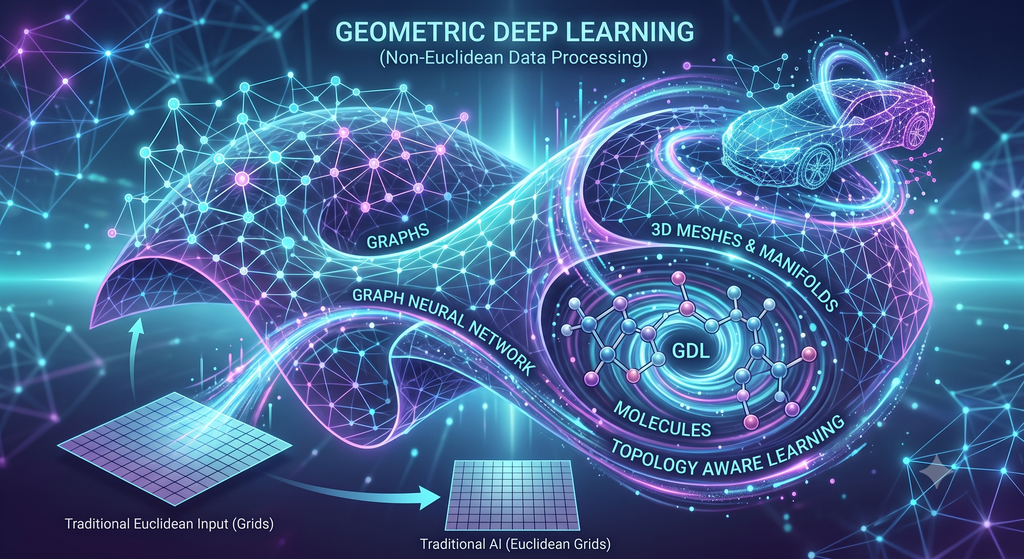
Welcome to this Complete Guide to Spatial AI, where we explore how machine learning is fundamentally transforming our physical world. For the past decade, artificial intelligence has changed how we interact with technology. It has achieved superhuman performance in natural language processing and computer vision. However, conventional machine learning models share a significant underlying limitation. Specifically, developers designed them to process data in flat, grid-like structures. These include one-dimensional text sequences or two-dimensional digital photographs.
Unfortunately, the real world is not flat. Furthermore, it is not neatly organized into perfect mathematical grids. To understand multi-dimensional, irregular structures, the artificial intelligence industry is rapidly pivoting toward a groundbreaking new field. Geometric deep learning is unlocking the next major frontier of machine learning. By enabling neural networks to process complex, non-Euclidean data natively, this technology drives unprecedented advancements. Consequently, it powers breakthroughs in spatial analytics, biotechnology, and autonomous systems.
Why You Need a Complete Guide to Spatial AI Today
Geometric deep learning serves as an umbrella term for emerging machine learning techniques. Specifically, researchers designed these techniques to learn from complex, non-Euclidean data. To fully grasp its importance, we must first understand the structural constraints of traditional AI models. Furthermore, we must understand why they fail when confronted with complex physical geometries.
The Limitations of Traditional Deep Learning Models
Standard deep learning architectures are highly optimized for Euclidean data. For example, Convolutional Neural Networks (CNNs) assume image data is organized in a fixed grid. Within this grid, distances between pixels are uniform and mathematically meaningful. Therefore, the algorithm slides a mathematical filter across this grid. This allows it to detect edges, shapes, and patterns easily.
However, a traditional CNN completely breaks down when analyzing irregular structures. For instance, it cannot process a 3D molecular structure or a sprawling social network graph effectively. In these domains, there is no fixed grid and no definitive “up” or “down”. Traditional deep learning models cannot natively comprehend these irregular structures without flattening them. Unfortunately, this flattening process inevitably destroys critical structural and relational information.
Processing Non-Euclidean Data
This Complete Guide to Spatial AI focuses heavily on solving this fundamental structural flaw. Geometric deep learning processes non-Euclidean data domains natively. Primarily, researchers categorize these domains into two distinct mathematical structures:
- Graphs: Mathematical structures consisting of nodes and edges. Nodes represent entities, while edges represent their relationships. Examples include social networks, global supply chains, and molecular bonds.
- Manifolds and 3D Objects: These are continuous geometric spaces. They look flat locally but curve globally. Examples include the 3D surface meshes of physical objects and complex LiDAR point clouds.
Geometric deep learning models leverage sophisticated mathematical principles like symmetry and invariance. Consequently, they extract meaningful patterns from these complex geometries. The models succeed regardless of how the data is rotated or shifted in three-dimensional space.
Core Architectures in Our Complete Guide to Spatial AI
The rapid rise of geometric deep learning relies on specialized neural network architectures. These architectures seamlessly navigate complex topological data without losing critical information.
Graph Neural Networks (GNNs) Explained
Graph Neural Networks (GNNs) are the most prominent subset of geometric deep learning. Specifically, engineers build GNNs to analyze graph-structured data. They operate through a sophisticated mathematical process called “message passing.” During this process, each node in a graph updates its own state. It accomplishes this by aggregating information from its immediate neighbors.
This precise mechanism allows the AI to understand complex relationships. For example, GNNs can map global financial transactions to detect sophisticated money laundering rings. Alternatively, they can analyze electrical grids for physical vulnerabilities. Therefore, GNNs provide a level of relational intelligence that standard AI models simply cannot match.
3D Deep Learning and Advanced Spatial Analytics
For physical domains, this Complete Guide to Spatial AI must highlight advanced 3D deep learning techniques. Traditional models process 3D objects by converting them into 2D images or rigid 3D cubes. Sadly, both methods are computationally heavy and lose fine details. In contrast, geometric deep learning models directly process raw point clouds. By ingesting this raw data natively, the AI perceives depth and volume accurately. Ultimately, this drastically reduces processing time while increasing overall spatial accuracy.
Transformative Real-World Applications
Geometric deep learning actively solves some of the most complex challenges across major global industries today.
Accelerating AI in Drug Discovery
Perhaps the most revolutionary application occurs in the pharmaceutical sector. Molecules are inherently graph-structured. Specifically, atoms function as nodes, and chemical bonds represent edges. Using geometric deep learning, researchers digitally model millions of molecular compounds. Consequently, they accurately predict how these compounds will interact with target proteins. This dramatically accelerates drug discovery, bypassing years of expensive laboratory synthesis.
Autonomous Driving and Advanced Robotics
Self-driving cars and drones rely heavily on LiDAR sensors. These sensors map the environment by bouncing lasers off physical objects. This generates a massive, unstructured 3D point cloud of the vehicle’s surroundings. Geometric deep learning allows autonomous systems to ingest these point clouds directly. By analyzing raw spatial data in real-time, the AI differentiates between pedestrians and stationary lampposts instantly. This results in incredibly safe and accurate spatial decision-making.
The Future Trajectory of Geometric Deep Learning
While geometric deep learning is exceptionally powerful, it remains an evolving discipline. Processing massive graphs with billions of edges requires immense computational power. Furthermore, researchers actively work to solve mathematical challenges related to “oversmoothing.” This issue occurs when Graph Neural Networks become too deep and lose unique details.
Despite these technical hurdles, the trajectory of machine learning is crystal clear. As we transition into a digital era dominated by augmented reality and advanced robotics, our data will change. It will increasingly reflect the complex, multi-dimensional nature of the physical world. Therefore, geometric deep learning provides the vital mathematical framework required to navigate this complexity. We hope this Complete Guide to Spatial AI helps you understand this foundational architecture for the next generation of artificial intelligence.