Complex Concept Summarization: Using AI to Decode Technical Research
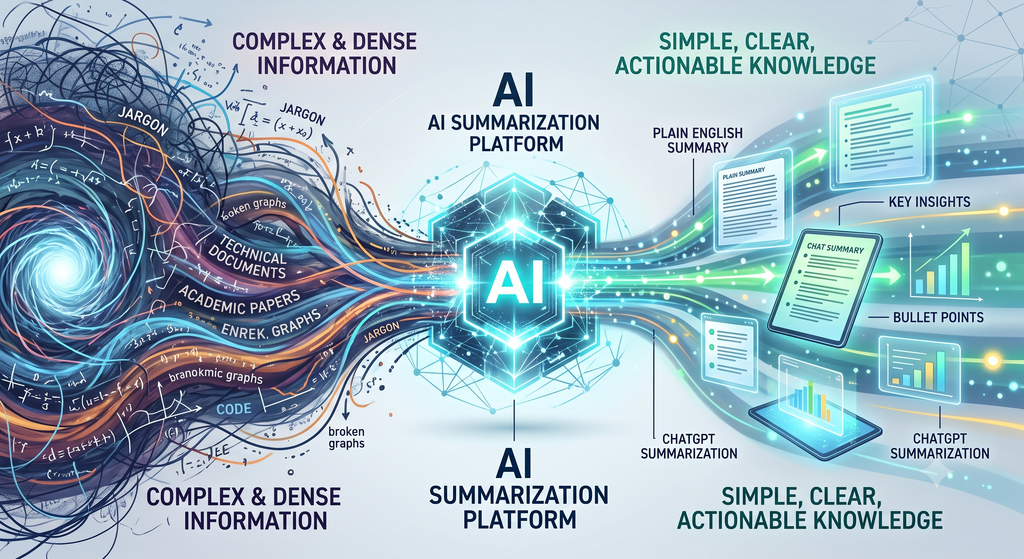
Professionals across all industries face a massive bottleneck today. Specifically, they must digest dense, highly technical information rapidly. For example, students analyze academic journals daily. Meanwhile, software developers read intricate API documentation. Consequently, extracting core insights takes entirely too much time. This is where complex concept summarization provides an immediate advantage. Therefore, modern AI platforms offer a perfect solution for knowledge workers.
Artificial intelligence tools like ChatGPT and Perplexity deliver immense value. Specifically, they break down long, complex academic papers effortlessly. Furthermore, they translate this dense data into simple, easy-to-understand words. As a result, users quickly grasp entirely new topics. In addition, professionals summarize vast amounts of research highly efficiently. Ultimately, this technology democratizes knowledge across non-technical corporate teams.
The Rise of AI Platforms in Knowledge Synthesis
Large language models (LLMs) have evolved significantly over the last two years. Initially, they acted merely as simple text generators. Now, they operate as deeply powerful analytical engines. Indeed, they move fluidly across legal, medical, and technical domains. Importantly, software developers do not need to retrain them from scratch for new subjects.
Why ChatGPT and Perplexity Lead the Market
The current AI landscape offers unparalleled versatility for open-ended professional tasks. For instance, platforms like ChatGPT excel at interactive, ongoing dialogue. Therefore, users can easily ask follow-up questions. This interactive process refines the summary until the complexity perfectly matches the user’s understanding.
Meanwhile, AI answer engines like Perplexity blend conversational AI with real-time web search. Consequently, they ground summaries of emerging technical research in up-to-date, cited sources. Furthermore, these platforms do not simply shorten the source text. Instead, they actively translate dense industry jargon into plain English. As a result, LLMs significantly lower the educational barrier to entry for non-experts. Therefore, anyone can interact with complex subjects using natural, everyday language.
Top Use Cases for AI-Driven Summarization
The ability to synthesize dense information actively transforms modern corporate workflows. Specifically, we see common applications across multiple high-stakes industries. In these critical sectors, professionals prioritize speed and analytical accuracy above all else.
Streamlining Academic and Scientific Research
Researchers and university students frequently use AI to process lengthy academic papers. Previously, they spent hours deciphering complex research methodologies. Now, users simply prompt an LLM to extract the core thesis immediately. Additionally, they ask the AI to identify key findings and critical limitations. Consequently, research teams conduct literature reviews at unprecedented speeds. Ultimately, this highlights the most relevant data points for further scientific study.
Simplifying Corporate and Legal Documentation
Legal contracts, compliance guidelines, and corporate earnings reports contain notoriously dense language. Therefore, legal teams deploy AI platforms to generate clear executive summaries. Specifically, these targeted summaries highlight potential risks, financial trends, and operational shifts. As a result, corporate decision-makers get the essential facts instantly. Furthermore, they avoid getting bogged down in confusing boilerplate text.
Explaining Technical Architecture to Stakeholders
In the software engineering space, non-technical product managers face distinct communication challenges. Specifically, they must understand complex backend system architecture. To solve this, they input API documentation into an AI platform. Subsequently, they request a high-level conceptual overview. Often, industry professionals call this the “Explain Like I’m 5” approach. Ultimately, this bridges the severe communication gap between engineers and business leaders. Therefore, teams align project goals perfectly without requiring deep coding expertise.
Prompt Engineering Best Practices for Accurate Summaries
Users must master prompt engineering to get the most accurate results possible. For example, providing a vague instruction like “summarize this” usually fails. Consequently, the AI generates generic, unhelpful, and brief outputs. In contrast, better prompt engineering reduces manual editing time. Furthermore, it improves output reliability dramatically. Most importantly, it ensures the AI produces focused insights tailored exactly to your professional needs.
Define a Clear Role and System Context
Role-based prompting serves as a critical foundational technique. Specifically, it shapes the AI’s perspective and improves output quality instantly. By assigning a persona, you directly guide the model’s professional tone. Furthermore, you firmly control the depth of its technical explanation.
Example Prompt: “Act as a senior data scientist. First, read this research paper on machine learning algorithms. Then, summarize it for a junior marketing analyst who lacks any coding experience.”
Use Constraint-Based Prompting for Better Focus
Constraints prevent the AI from generating off-topic fluff. Therefore, you must clearly define the desired length and formatting rules.
- Specify exact formatting: Require the AI to output bulleted lists or Markdown tables. Consequently, you make the synthesized data instantly machine-readable.
- Set strict scope limits: Explicitly tell the model what details to focus on. For instance, restrict the summary strictly to the methodology section. Meanwhile, instruct the model to completely ignore the historical background.
Implement Chain-of-Thought Reasoning
Dense technical research requires careful, methodical handling. Therefore, force the AI to break down its summarization step-by-step. For example, ask the model to identify the core problem first. Next, tell it to outline the testing methodology. Finally, request a simplified explanation of the results. Ultimately, this structured approach improves multi-step accuracy significantly. In addition, it makes the AI’s internal reasoning highly traceable.
Utilize Few-Shot Prompting for Consistency
Sometimes, you need the AI to match a specific corporate writing style. In these situations, giving zero examples yields highly inconsistent results. Instead, you should utilize few-shot prompting techniques. Specifically, provide the AI with two examples of ideal, human-written summaries. Afterward, ask it to process the new text using that style. Consequently, this technique teaches the model your preferred structural pattern. As a result, the final output aligns perfectly with your team’s expectations.
The Risks: Overgeneralization and Algorithmic Bias
AI platforms provide undeniably powerful summarization capabilities. However, relying on them completely blindly carries significant professional risks. Therefore, users must mitigate these issues to prevent corporate misinformation.
The Danger of Scientific Overgeneralization
When summarizing scientific texts, LLMs sometimes omit critical contextual nuances. Consequently, they limit the precise scope of the actual research conclusions. For example, researchers recently tested prominent models like ChatGPT. They found that LLM-generated summaries frequently contained excessively broad generalizations. Specifically, AI models were nearly five times more likely to overgeneralize compared to human writers.
Therefore, the AI might present a conditional finding as a universal fact. In the study, models overgeneralized scientific results constantly. Ultimately, this poses a massive risk for the misinterpretation of data.
Mitigating Bias in AI Summaries
Developers train LLMs on massive, internet-scale datasets. As a result, these models inadvertently inherit societal, cultural, and political biases. When summarizing highly subjective research, the AI might subtly favor one perspective. Therefore, professionals must remain highly vigilant.
Essential Strategies for Safer AI Summarization
First, utilize lower temperature settings within the AI platform. Reducing the AI’s creativity setting forces it to stick to the literal text. Consequently, this reduces the likelihood of AI hallucinations dramatically.
Second, always prompt the AI for analytical trade-offs. Specifically, ask the AI to document the exact limitations mentioned in the source material.
Finally, implement strict human-in-the-loop verification protocols. You must never treat an AI summary as a finalized product. Instead, use it as a navigational tool to guide your reading. Consequently, you will ensure critical nuances remain entirely intact.
By mastering advanced prompt engineering, users unlock massive productivity gains. Furthermore, by actively mitigating known risks, you ensure high analytical accuracy. Ultimately, mastering complex concept summarization helps you turn overwhelming technical research into clear, actionable knowledge.